I watched a retelling of Cinderella that absolutely gutted me because it was so sad, so unjust. I’m not going to link to it because I’m about to give major spoilers, but if you’d like to see it, message me. This adult version of the story was told from the perspective of one of the stepsisters, Drizilla, and in it, Cinderella was a manipulative psychopath who lied, cheated, and stole. The story ends with Drizella in a sanatorium, not visited by a single person, while Cinderella became a princess.
So again, not a “happily ever after” kind of story. Not a “feel-good” kind of story. It was a brutal story that touched on something very important, which Drizella said near the end: “No one really wants the truth. Not when the truth is ugly, and the liar is beautiful.” Yeeees. The truth is ugly, uncomfortable. It often asks something of us. It forces us to look at something we’d rather not look at because it challenges our worldview or a belief we have about someone or ourselves. It’s much easier, in some ways, to keep living a lie.
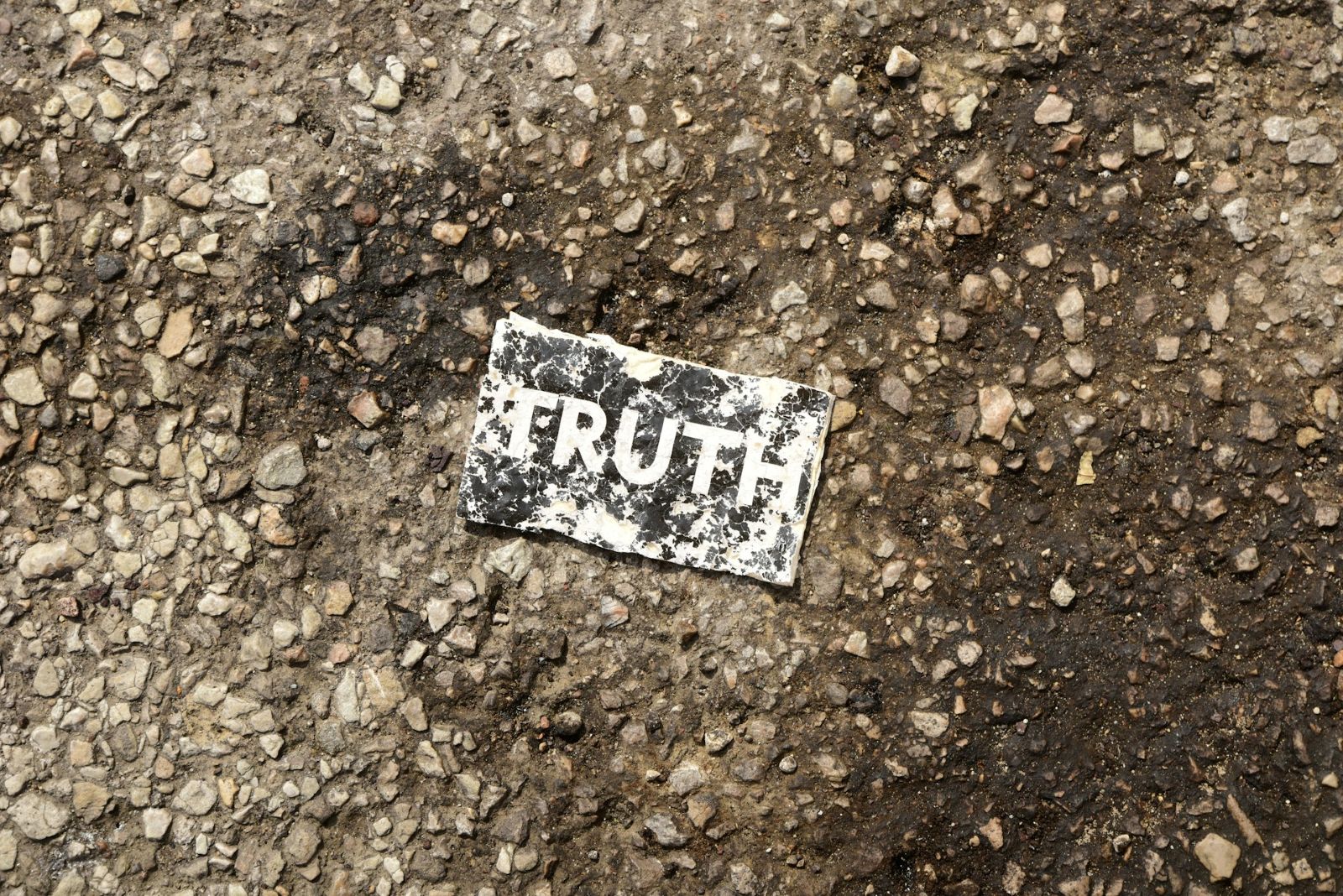
Sometimes the truth is ugly. Photo by Michael Carruth on Unsplash
I see this with politics – elected officials lie all the time. They sell a story because it sounds good. It’s much easier to say, “We’re investigating fraud in states that just happen to be Democratic-led,” rather than, “We plan to bully and terrorize people who disagree with us.” It sounds reasonable to investigate fraud, which it is, but why is the investigation selective? That’s not a baseless example, by the way. In the past few days, the Trump Administration announced it is investigating fraud in 14 blue states. But just the blue ones, not the red ones. How convenient.
But here’s the thing about truth. As Elizabeth Gilbert wrote in her latest memoir, “The truth has legs. It always stands. When everything else in the room has blown up or dissolved away, the only thing left standing will be the truth.” The way I like to think of it is you cannot escape reality. It will grab you by the collar and shake you. It will force you to look it in the face even when every part of you is trying to turn your head. You cannot escape reality any more than you can escape death.
This relates to spirituality because in Sanskrit, the unchangeable entity is Sat. The external manifestation of Sat is satya, or benevolent truthfulness. My spiritual teacher said, “Only satya or truth triumphs and not falsehood. Whenever there is a clash between truth and untruth, truth’s victory is inevitable. … Untruth, being a moving phenomenon, may attain a temporary victory on its march, but never a permanent one. … Falsehood does not win because it is relative, it is ever-changing.”
I take comfort in knowing that eventually the truth will come out. That falsehood doesn’t win because it goes against the unchangeable entity. That people can try to run away from the truth but they can’t run forever. Eventually, truth finds us all and the question becomes, what are we going to do about it?
I dream of a world where we understand a lie is often easier to swallow than the truth. A world where we recognize that even though it seems like lies are winning, their victory is only temporary. A world where we recognize we cannot escape the truth even if we try. A world where we remember the truth always comes out eventually, even when it’s ugly.
Another world is not only possible, it’s probable.
I had an interesting experience with certainty on Saturday night. I went to a Democratic Socialists of America teach-in where they discussed how veganism feeds anticapitalism and vice versa. They served dinner and I was SURE I’d be able to eat almost nothing because while I’m vegan, I don’t eat onions and garlic, which are basically in everything. It turns out they ordered food from one of a handful of restaurants that don’t cook with those ingredients!
And then on the way home, all the transit apps said my bus was on time (it wasn’t). I was certain I’d missed my connecting bus because of the delay, which, again, all of the transit apps said would be the case, but I didn’t! The connecting bus was also late, which meant I waited a grand total of 2 minutes rather than the 15 I begrudgingly anticipated. Here was the trickster working in my favor. I usually think of the trickster as the disruptive force that makes it rain on your wedding day, but sometimes the trickster can work to your benefit.
These experiences around uncertainty reminded me of a quote a friend shared. Painter Paul Cézanne said, “We live in a rainbow of chaos.” I don’t know about you but I don’t naturally associate “rainbow” with “chaos.” I don’t think of chaos and unpredictability as beautiful. I think of them as dark, ugly, something to be avoided at all costs. But that’s not the full story, is it? As the Post-It note on my bathroom mirror says, “Remember: Life can be surprising and delightful.”
Is it a rainbow? Yes? It is chaos? Also yes. Photo by Luca Upper on Unsplash
Life can be chaotic and beautiful. Uncertain and joyful. It’s all of it. Life is a broad range of experiences and I do better when I embrace that. There’s a psychological concept that supports this called emodiversity, which means letting yourself feel an abundant range of emotions – not just the pleasant ones. A study of 37,000 people found that those who do that have better mental health, decreased depression, better physical health, and know how to handle a wide range of behavioral situations.
Diversity is the name of the game over and over again. Diversity in emotions. Diversity in the gut microbiome. Diversity in the gene pool. We are stronger with diversity. My spiritual teacher says:
“Some people say that disparity is the order of nature; therefore, there must be differences between one group and another, between rich and poor, etc. However, such a proposition is fundamentally incorrect. Instead, it is correct to say that diversity is the order of providence. One must remember that identicality is disowned by nature – nature will not support identicality. Whenever identicality occurs, a sort of structural explosion takes place and the entire structure is broken into pieces. So diversity is the law of nature and identicality can never be.”
He’s talking specifically about social structures but the concept also applies to our internal diversity, or in this case, our internal range of emotions and experiences. Life is meant to be a rainbow of chaos, and instead of becoming something to fear, I’m learning it’s something I can enjoy.
I dream of a world where we recognize the only certainty we’ll ever have is that life is uncertain. A world where we understand chaos and unpredictability don’t have to be bad things. A world where we embrace our full range of emotions and accept diversity internally and externally. A world where we remember we live in a rainbow of chaos.
Another world is not only possible, it’s probable.
A few people have said to me they don’t feel particularly motivated right now, that they’re low energy, and just generally not feeling amazing. What keeps coming to mind is a post I wrote in November 2021 about letting things be terrible. Even though I’m not recovering from a car accident or participating in the now-defunct NaNoWriMo organization challenge, this post still feels relevant. Enjoy.
Right now, I’m engaging in NaNoWriMo (National Novel Writing Month), which means I’m aiming to write 50,000 words in a month. For the uninitiated, that’s a novel the length of The Great Gatsby. It’s approximately 75 pages single-spaced in a Word processing document. I’m pretty sure this new novel I’m working on is the worst piece of writing in the known universe, but I’m pressing forward. (Side note from 2026 me: It took me four years to finish it, but I’m incredibly proud of the novel I worked on during NaNoWriMo, and the people who’ve read it all told me that I wrote something wonderful. I’m currently pitching the book to literary agents.)
The advice for those writing during NaNoWriMo is to tame your inner editor. Instead of hitting the “delete” key when you think something sounds awful, just keep putting words on the page. Let the writing be bad. There’s something liberating in indulging in that mentality. To revel in it. To acknowledge, “I know this can be said better, but I don’t care.”
As someone with a history of perfectionism, it’s difficult for me to stop judging end results, but that’s what I’m encouraging myself to do right now. I’m acknowledging the new novel is bad, that it will likely change a lot before I’m finished, but I’m letting that be OK. I’m not nitpicking myself in the moment and instead giving myself freedom to relax, to explore, to try new things on the page. It’s fun!
Let it be terrible sometimes. Photo by Vitaly Gariev on Unsplash
I notice this principle, “Let it suck,” applies not only to creative projects, but also to the physical body (sometimes). Headline: I’m fine, but on Saturday night, I was in a car accident. While driving through an intersection, a car ran a red light and hit the driver’s side of my friend’s car. We swerved to the right, and the impact jostled me so I banged up my elbow and knees against the console very, very minorly. It’s my right shoulder blade that hurts this morning from the whiplash.
I took out a tennis ball and massaged the shoulder blade, but it still hurts. Nothing is dislocated; it just hurts. Because I was in a car accident. And instead of rushing to fix it, change it, solve it, I said to the pain, “I’m here. I’m listening, body.” I’m letting the pain be here, I’m letting things suck because sometimes that’s all we can do. The body heals on its own timeframe and that doesn’t necessarily mean something is wrong.
It reminds me of this NY Times article I read a few years ago, where an American woman had a hysterectomy in Germany. When she asked about painkillers post-surgery, her medical team said she’d be given ibuprofen, and that’s it. When she talked to one of her doctors about it, he said, “Pain is a part of life. We cannot eliminate it, nor do we want to. The pain will guide you. You will know when to rest more; you will know when you are healing. If I give you Vicodin, you will no longer feel the pain, yes, but you will no longer know what your body is telling you. You might overexert yourself because you are no longer feeling the pain signals. All you need is rest.”
It confounded her, but it turned out her doctors were right. She didn’t need painkillers – she needed rest and patience. She let things suck, she let her body feel terrible, and that was her wisest course of action. For this month, I, too, am letting things suck in more ways than I anticipated, and that perhaps is a greater accomplishment than writing the worst novel the world has ever seen in the course of 30 days.
I dream of a world where we let things suck sometimes. A world where we let our creativity flow without any hindrance. A world where we check our self-editors at the door. A world where we let ourselves feel pain when it arises because it provides us with important information to guide our lives and direct our attention.
Another world is not only possible, it’s probable.
I just finished Elizabeth Gilbert’s latest memoir, All the Way to the River, and a few lines jumped out at me. In one art piece (because the memoir includes her doodles), she writes, “Replacing fantasies with different fantasies is not a good idea. Trade fantasy, which has a storyline, with mystery, which does not.”
As we open this new year, that feels like the best possible advice I could hear. So much of 2025 was a dismantling of fantasies and storylines for me. It was understanding that happily ever after doesn’t exist, and instead, life is a wheel. It was also a lesson in realizing that plans will always go awry, and it’s better for me to plan for that, or in other words, to welcome the trickster.
I want to be omniscient. I want to know everything right now, but as my former therapist used to say, “How’s that working out for you?” My friend, it is not working out for me. Not even a little. Trading one fantasy for another, one plan for another, only sets me up for disappointment. Honestly, I’m a little tired of disappointment. I’d like to get off this ride, please.
Abstract art! Always mysterious! Photo by Jr Korpa on Unsplash
And even though my spiritual practice advocates recognizing our true nature, i.e., that we are all divine, or spiritual beings having a human experience, my teacher does NOT say we should try to know everything. In fact, he says, Cosmic Consciousness has been “creating this unique, colorful world with His various powers. Why He is doing so is known to Him alone; no one else knows it. … It is a fact that human beings with their limited intellect can never understand the secrets of why and how [God] has been creating this universe; their wisdom can never fathom this mystery.”
Instead of trying to puzzle everything out, my teacher says, “You should think, ‘My little intellect cannot fathom all this – rather let me do one thing, let me establish a relation of sweet love with Him,’” because ultimately, that’s the only thing that brings relief anyway.
In Liz’s poem “God Responds to My Withdrawal,” she touches on this, writing from the perspective of God. Here are a few excerpts:
Nothing you could ever feel
is bigger than what I can hold.
Let me surround you with holy silence, then
while you struggle.
Let me embrace you with my infinite mystery
while you rage.
….
Being everywhere, I have nowhere better to be.
Being everything, I have nothing better to do.
Bring it all to me, then.
….
Feel everything you need to feel, my child–
but feel me, too, in this unrelenting furnace.
Feel me, too.
As people, places, and things continue to baffle me, the best I can do is keep developing a loving relationship with myself and with my Higher Power. And instead of replacing one storyline with another, I’m better served by living in the mystery.
I dream of a world where we recognize our plans will always go awry. A world where we stop trying to shoehorn life into a particular storyline. A world where we turn inward for comfort and relief. A world where instead of trying to be omniscient, we make peace with living in the mystery.
Another world is not only possible, it’s probable.