I love rainbows. Even if I’m the one making a rainbow appear with a gardening hose, every time I see one, it feels like a gift. They speak to me of joy, promise, and beauty. The other week, I learned something about rainbows that makes me love them even more. You might already know this, but first off, a rainbow is an optical illusion. It doesn’t exist in a specific spot in the sky – it appears depending on where you’re viewing it and where the sun or other source of light is shining.
You, as the viewer, have the light source behind you, and the rainbow is the imaginary point exactly opposite the light source, which is called the “antisolar point.” Below is a nifty graphic illustrating this.
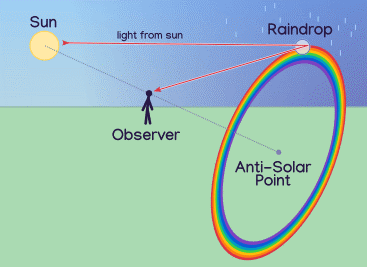
Rainbows form like this!
As you can see from the image, rainbows are full circles, and the antisolar point is at the center of the circle. Essentially, what this means is you are the center of every rainbow. And here’s where I think it gets even cooler. Per National Geographic, “[N]o one sees the same rainbow—each person has a different antisolar point, each person has a different horizon. Someone who appears below or near the ‘end’ of a rainbow to one viewer will see another rainbow, extending from his or her own horizon.”
The rainbow moves as you move. As this science website puts it, “Essentially, an infinite cone is formed with the viewer at the point, the rainbow as the surface of the cone, and the antisolar line as the central axis. A cone is made because the [water] drops are spherical, and the light that exits them is angled, which forms a cone when spun around…Each person has their own cone that waterdrops will reflect.”
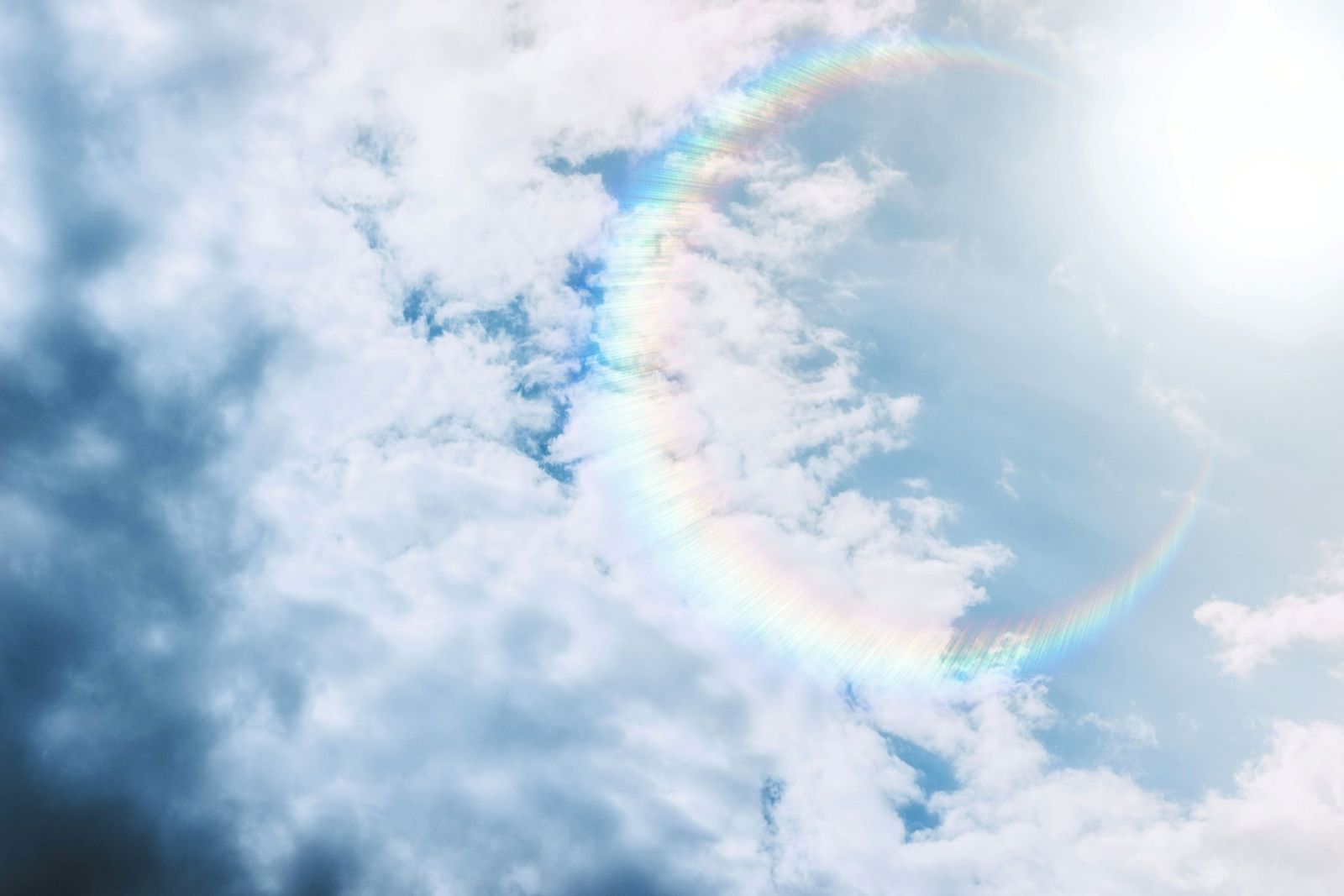
We have our own little cone to create a rainbow. Photo by Mathias Reding on Unsplash
Each person has their own cone. Each person has their own rainbow. And more than that, we are each encased in our own rainbow circle. It’s special and unique to us, even if we’re standing next to someone else looking at the same thing. It’s not quite the same rainbow because fundamentally, we are each the center of every rainbow. This reminds me of a concept from my spiritual tradition.
My spiritual teacher says that the secret of meditation is to think the Divine Beloved is meditating on you, not the other way around. The secret is to imagine we are each being showered with untold bliss and love – not that we have to go chase after it or think of the thing that we love. It’s to hold the ideation that we are the center of love, that we are the beloved. To me, learning that we are the center of every rainbow is a physical manifestation of that idea. I’m looking out, seeing something beautiful and precious, but I am at the center of it. That beautiful and precious thing wouldn’t exist without me there to witness it.
I dream of a world where we remember we are each being showered with love all the time. A world where we understand we don’t have to seek outside ourselves for something beautiful, precious, or unique. A world where we recognize every rainbow is just for us. A world where we remember, we are the center of every rainbow.
Another world is not only possible, it’s probable.
You may already know this, but AI safety researcher Mrinank Sharma resigned recently. That’s not really news in and of itself – people leave their positions all the time. No, the newsworthy part is that he left Anthropic, best known for its chatbot Claude, to study, drumroll please: poetry. Yes, poetry.
The context is what makes the whole thing fascinating. My friend and narrative astrologer Ada Pembroke sums it up nicely: “[S]omeone who spent years trying to build AI safety guardrails has decided the answer isn’t better guardrails. The answer is wisdom. And he’s going to look for wisdom the way humans always have: through art, through language that means more than one thing, through the practice of courageous speech.”
To be honest with you, I struggle with poetry. I’m a highly literal person and I want people to say what they mean and mean what they say. But Ada suggests poetry is powerful precisely because it’s not that (mostly). Poetry collapses multiple symbols all into one. It encourages us to dive deeper, to look again, and that’s what AI cannot do because it, too, is very literal. And per her second point, poetry can be courageous.
The pen is still mighty! Photo by Aaron Burden on Unsplash
I’ve known for ages that journalists are frequently jailed for their writing. Reporting the truth can be dangerous in a time when governments want to function on lies. What permeated my brain less is that poets are also jailed. In 2024, 375 writers were jailed in connection with their speech, according to PEN America’s Freedom to Write Index, and 67 of them were poets. In Myanmar, poets led protests with poetry readings to support civil resistance following the military’s February 2021 coup; several were arrested and detained.
In Iran, poets who posted and recited poetry on social media were arrested by authorities looking to silence support for the Woman, Life, Freedom movement. In a few places, poets are jailed not for months but for years. As PEN America puts it: “Authoritarian leaders target poets because their words – filled with lyricism, story, and feeling – can expose the cracks of oppression in daily life.”
My spiritual teacher encourages people to make art not for art’s sake but for service and blessedness, meaning, to spur their love of the divine. He says artists are pioneers and can lead society forward. Literature in particular is “that which moves together with the society, which leads society towards true fulfillment and welfare by providing the inspiration for service,” he says. “People seek deliverance from the whirlpools of darkness; they aspire to illuminate their lives and minds with ever-new light. In all their actions, in all their feelings, there is an inherent tendency to move forward; therefore, if at all they are to be offered something, the creator of art cannot remain idle or inert.”
What my spiritual teacher is pointing to is the power of art. It’s not merely commerce, a way to make a quick buck, but a tool for good or evil. Art influences people, whether they want to admit it or not, and in this age of AI slop, original, human-created art that speaks to the times we live in is potent.
I dream of a world where we remember that art still matters. A world where we understand there can be more to art than just amusing people or trying to capitalize on a trend. A world where we remember art and literature can be a tool of service and inspiration. A world where we recognize the power of art and use it accordingly.
Another world is not only possible, it’s probable.
When life gets stressful or complicated, I notice a tendency in me (and in some people I know) to make things even more stressful, even more complicated. I don’t know why exactly, but I suspect it’s because when people are scared, they start scanning for threats and want to resolve them all. It feels protective to try to fix everything. I don’t know about you, but for me, that only makes things worse.
Trying to do more when I’m already stressed and overwhelmed only ends in disaster, and my body pays the price. So instead, I have to remind myself, “Keep it simple.” Instead of raising the bar, I lower it. Rather than making dinner from scratch, I heat prepared food. Rather than making big decisions, I set those aside. It’s not what I want to do, but I’m learning that when I’m running hot, for whatever reason, the best thing for me is to turn down the temperature. This is also the advice I’m giving to others.
A few of my friends are going through some major challenges and they’re spinning out about what’s next. When they call me, I’m not helping them problem-solve (usually). Instead, I say to them, “Breathe with me. Inhale for four seconds, hold for two, and exhale for six.” And then we do that together for a couple of minutes. That’s it. Just breathe together. And then to orient them to the here and now, I ask them to tell me five things they can see, four things they can touch (and actually touch them), three things they can hear, two things they can smell, and one thing they can taste.
So simple. So lovely. Photo by Tyler Lastovich on Unsplash
We make everything very simple. We come back to this body, this breath, and then the very next right action. That could be making dinner or taking a shower or going to bed. Big decisions, ferreting out the truth, and analyzing the world are activities for when we’re regulated, not when we’re activated. There’s a part of me saying, “Really, Rebekah? You’re writing about self-regulation and keeping things simple? That’s the message you want to share this week? Not explaining the origins of the universe? Or illuminating some grand spiritual concept? This? This?” The answer is “yes.”
One of my favorite quotes about spirituality is, “There’s only one path to God, and that’s through the spine.” Some people think of spirituality as something “out there,” or that the human body is a nuisance. It’s not. The body is the path to enlightenment because everything happens to or in the body. And so that means in some ways there’s nothing more profound, nothing more sacred, than taking care of this form. And “taking care of” isn’t just eating nourishing food and exercising. It’s also supporting the nervous system. It’s actively putting ourselves back into a place of spaciousness.
Note that I said “spaciousness” and not “calm.” That was intentional because there are times we shouldn’t be calm. There are times when it makes complete sense to feel angry or sad or scared. But you can feel angry and not become reactive. You can feel sad and not let it consume you. That’s what breathing deeply and orienting toward the physical space around you does – creates a little more separation, a little more choice.
In this day and age where there are about a billion things that can elicit strong emotions and keep us operating from our limbic systems, I can think of no more powerful suggestion than, “Keep it simple.” Because when we do, we’re telling ourselves, “I matter.” And that’s true.
I dream of a world where we understand that when we want to complicate things, that’s likely when we most need to simplify. A world where we pause, breathe, and orient to what’s before us. A world where we do the next right action. A world where we keep it simple.
Another world is not only possible, it’s probable.
I wrote this post in April 2019 after I was fired from a job that wouldn’t let me work from home two days a week, despite having a doctor’s note saying I needed that setup. Oh, the irony that a year later everyone was working from home. . .Despite different circumstances, this post is still relevant today. Enjoy.
You know how people say most of the things they’re afraid of never happen? The opposite is true for me – most of the things I’ve feared have happened. Not the fleeting, “I’m scared I’ll miss my flight” things, but the “I’m scared I’ll be broken into” things. The recurring fears, the ones that cause my stomach to roil and my chest to constrict.
I want to take a moment here to recognize my fears are those of a privileged white woman. I totally understand that other people lead tougher lives than I do, with fears greater than mine. I understand I have a relatively easy, cushy life. I’m not here to get into a competition about that. Rather, the point of this post is to talk about fear and resilience.
For much of my life, I’ve braced myself for terrible things. I’ve done my best to ward them off, but they happened anyway. And because they happened, I feel less afraid now. I no longer have to fear the worst because the worst has happened and I’ve lived to tell the tale. It also means I know how to take care of myself in challenging times. If I have to endure a hardship again, I will because I did before.
We are more powerful than we know. Photo by Felix Mittermeier on Unsplash
Researcher and storyteller Brené Brown writes about this character trait, resilience, in her book Rising Strong. She said, “While vulnerability is the birthplace of many of the fulfilling experiences we long for – love, belonging, joy, creativity, and trust, to name a few – the process of regaining our emotional footing in the midst of struggle is where our courage is tested and our values are forged. Rising strong after a fall is how we cultivate wholeheartedness in our lives; it’s the process that teaches us the most about who we are.”
Check and check. I used to think of myself as a scaredy cat. As someone sensitive and fragile. And I am, but at the same time, I’m also tough. I’m brave. I’m strong. I’m resilient. I pick myself up again and again. When life kicks me in the teeth, I collapse, I cry, but then I do the hard thing and move through it. I’ve already surmounted many obstacles in my life. And I know if I don’t currently have the tools to get through whatever is before me, I will hunt tirelessly to find the right ones. This ties into spirituality because the backbone is faith.
My spiritual teacher says over and over again if a person takes shelter in the Supreme, they need not be afraid of anything in this world. That the divine is “more courageous than the most courageous and braver than the bravest. Those who take shelter in [the divine] are therefore bound to acquire these qualities: courage, bravery, chivalry, and so on. Once endowed with such qualities, what is there to fear?”
I’m a human being, so I still fear many things, but I know the more I lean into the presence of my higher power, the better I feel. The more I surrender, the more I recognize everything is an expression of an infinite loving consciousness; the more relaxed I become, and also the more fearless. There’s a quote floating around about how the devil whispered in a warrior’s ear: “You’re not strong enough to withstand the storm.” And then the warrior responded, “I am the storm.” That’s what it feels like right now. And if you’re going through a hard time, I hope you can muster up that same spirit.
I dream of a world where we recognize our resilience. A world where we understand we’re able to tackle all the challenges coming our way. A world where we become more and more fearless because we understand not only are we strong enough to withstand the storm, but that we are the storm.
Another world is not only possible, it’s probable.
Something that’s on my mind a lot is the desire for one-and-done. I want the magic pill, the silver bullet, the “do this once and everything is fixed” solution. I see this in myself but I also see it in the rhetoric we use when talking about the world writ large. “Save the world,” we say, as if the planet is in need of rescuing. That’s what “saving” means, by the way, to rescue from impending danger. Here’s the thing, though: When in human history have we as a species not been in impending danger? Seriously, when?
Our ancestors were in danger on a smaller scale but no less threatening – danger from food scarcity, warring tribes, diseases, and more. As we edged toward globalization, the threats became even larger and more climactic, literally. We still have danger from food scarcity, war, and diseases, but now we also have danger from things like extreme weather. And as we’re seeing, we’re all connected. A storm in the northeast can affect people in the southwest.
We talk about saving the world as if we haven’t had to confront these issues a million times in the past. As if we haven’t already had to deal with government-sanctioned murder. As if we haven’t already faced extreme exploitation or inequality. As if we haven’t already dealt with harsh weather conditions. The circumstances, the specifics, they are all different, yes, absolutely. But the heart? The themes? Practically timeless.
Maybe it’s more about relationality. Photo by Alin Andersen on Unsplash
So what I keep wondering is, can the world be saved? Is there a silver bullet that fixes everything? Very clearly, the answer is “no.” When we talk about “saving the world,” we couch it not only as a one-time fix, but we also subtly create this individualist burden. Doing so makes “saving the world” your personal responsibility. But it’s not. We are in relationship with this planet and each other. No one person can “save” the world and nor should they.
Something my spiritual teacher talks about frequently is “coordinated cooperation.” It’s when cooperation is between free human beings, each with equal rights, mutual respect for each other, and they are working for the welfare of the other. What we see more frequently is subordinated cooperation, which is the traditional power structure whereby power is top-down. It’s someone, or a group of someones, imposing their will. But it never works.
To quote my spiritual teacher, “Only the cooperative system can ensure the healthy, integrated progress of humanity, and establish complete and everlasting unity among the human race. People should work to enjoy sweeter fruits by establishing the cooperative system.”
A cooperative system cannot exist if one group is considered inferior to another. Nor can coordinated cooperation exist if it’s imposed upon the group. I believe the same is true with the planet as a whole. We humans think we know what the planet needs, but how can we possibly know if we don’t have a relationship with it yet? That’s like us diverting a river and then being surprised when there are unintended consequences.
I don’t think the world needs to be “saved,” I think it, and we, need empowerment via mutuality and relationality. The planet as a whole needs tending, serving, stewarding, not domineering. Not imposing power over, but power with as an equal player, an active participant. And part of being an active participant means recognizing there is no “one-and-done.” There is no magic pill or silver bullet. If we want to serve the world, if we want to shepherd it into a more harmonious place, we do that over and over again, one day at a time.
I dream of a world where we recognize we aren’t saviors, we’re stewards. A world where we recognize no one person has the power to solve everything all at once. A world where instead of creating power over, we create power with. A world where we understand if we really want to support people and the planet, it requires an ongoing, mutual relationship, not a white knight.
Another world is not only possible, it’s probable.
I just finished Elizabeth Gilbert’s latest memoir, All the Way to the River, and a few lines jumped out at me. In one art piece (because the memoir includes her doodles), she writes, “Replacing fantasies with different fantasies is not a good idea. Trade fantasy, which has a storyline, with mystery, which does not.”
As we open this new year, that feels like the best possible advice I could hear. So much of 2025 was a dismantling of fantasies and storylines for me. It was understanding that happily ever after doesn’t exist, and instead, life is a wheel. It was also a lesson in realizing that plans will always go awry, and it’s better for me to plan for that, or in other words, to welcome the trickster.
I want to be omniscient. I want to know everything right now, but as my former therapist used to say, “How’s that working out for you?” My friend, it is not working out for me. Not even a little. Trading one fantasy for another, one plan for another, only sets me up for disappointment. Honestly, I’m a little tired of disappointment. I’d like to get off this ride, please.
Abstract art! Always mysterious! Photo by Jr Korpa on Unsplash
And even though my spiritual practice advocates recognizing our true nature, i.e., that we are all divine, or spiritual beings having a human experience, my teacher does NOT say we should try to know everything. In fact, he says, Cosmic Consciousness has been “creating this unique, colorful world with His various powers. Why He is doing so is known to Him alone; no one else knows it. … It is a fact that human beings with their limited intellect can never understand the secrets of why and how [God] has been creating this universe; their wisdom can never fathom this mystery.”
Instead of trying to puzzle everything out, my teacher says, “You should think, ‘My little intellect cannot fathom all this – rather let me do one thing, let me establish a relation of sweet love with Him,’” because ultimately, that’s the only thing that brings relief anyway.
In Liz’s poem “God Responds to My Withdrawal,” she touches on this, writing from the perspective of God. Here are a few excerpts:
Nothing you could ever feel
is bigger than what I can hold.
Let me surround you with holy silence, then
while you struggle.
Let me embrace you with my infinite mystery
while you rage.
….
Being everywhere, I have nowhere better to be.
Being everything, I have nothing better to do.
Bring it all to me, then.
….
Feel everything you need to feel, my child–
but feel me, too, in this unrelenting furnace.
Feel me, too.
As people, places, and things continue to baffle me, the best I can do is keep developing a loving relationship with myself and with my Higher Power. And instead of replacing one storyline with another, I’m better served by living in the mystery.
I dream of a world where we recognize our plans will always go awry. A world where we stop trying to shoehorn life into a particular storyline. A world where we turn inward for comfort and relief. A world where instead of trying to be omniscient, we make peace with living in the mystery.
Another world is not only possible, it’s probable.
I watched a clip of Netflix’s “Famous Last Words: Jane Goodall” and started tearing up. That woman was an icon, a messenger of hope, and someone who remained consistent until her dying breath. She exemplified neohumanism, a concept in my spiritual tradition, that begs the question, “What is the boundary of your identity?”
Neohumanism encourages bridge building not only with other people, but also with plants and animals. For Jane, she saw animals not as heartless brutes, but as beings that have rich inner lives just as humans do. They cry, experience joy, and have other emotions. From a Mongabay news piece I read, “She blurred the categorical wall that placed humans above other animals. Her work became foundational not only for primatology, but for animal welfare and environmental ethics.”
But she wasn’t an animal rights activist who said, “Screw all the humans! You’re terrible!” Instead, she tried to connect with people she didn’t see eye-to-eye with. She said, “If you don’t talk to people you disagree with, how can you expect them to change?” She understood that being a purist or isolating yourself from others only creates more isolation, and what this planet actually needs is people working together.
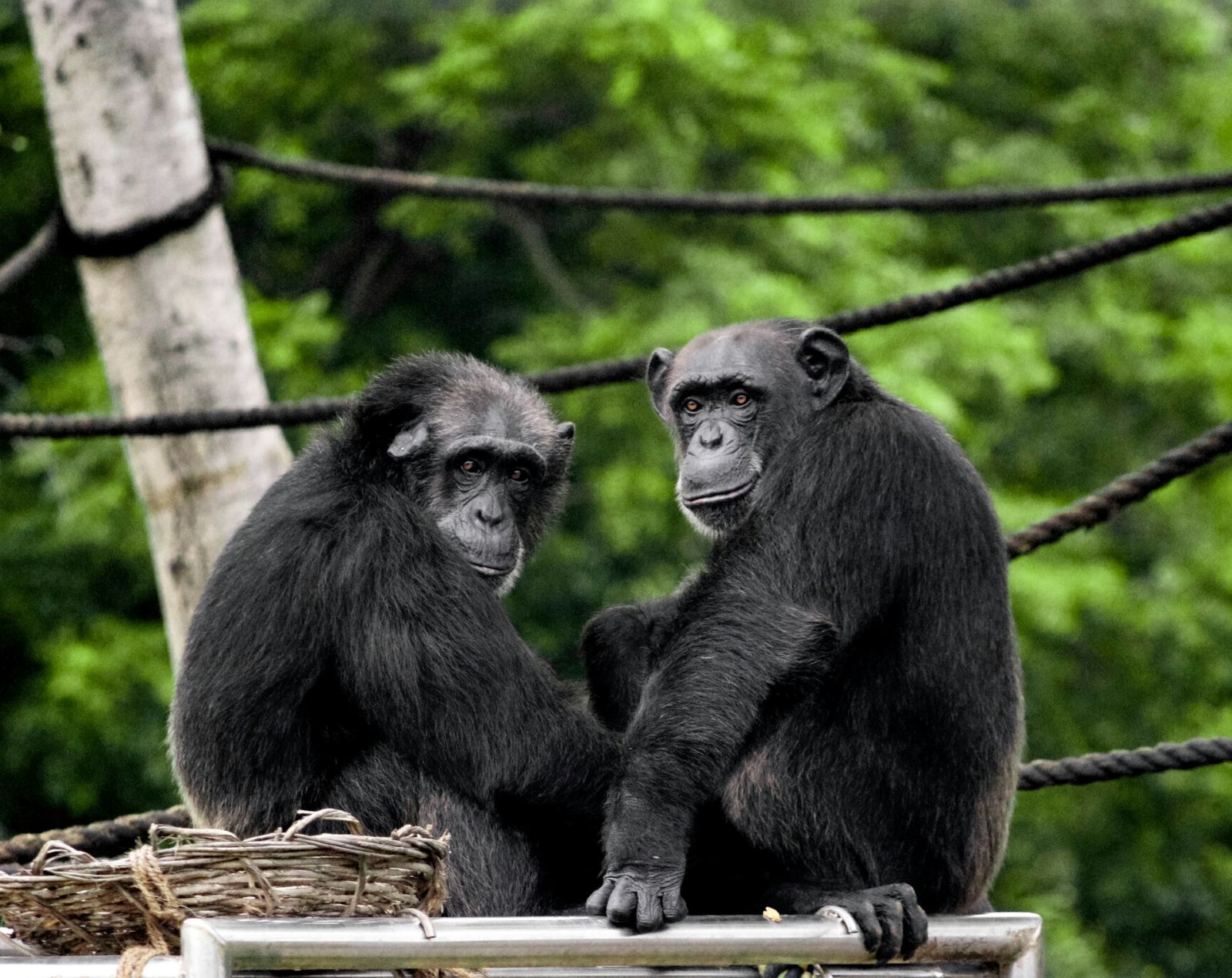
In honor of Jane, of course. Photo by Satya deep on Unsplash
Jane also followed up her words with actions by creating Roots & Shoots, a youth action program that empowers young people to be the change in their communities. It spans more than 140 countries and has projects ranging from recycling drives and community gardens to tree-planting campaigns and animal rescues. Underpinning the youth movement, and Jane’s ethos in general, is that every action matters.
“You cannot get through a single day without having an impact on the world around you,” Jane often reminded her audiences. “What you do makes a difference, and you have to decide what kind of difference you want to make.”
I keep thinking about that quote, and like I wrote about last week, that each of us has influence even if we’re not an influencer. If we accept it as fact that we impact the world every single day, what kind of impact do we want to have? Some people are hellbent on impacting the world negatively by cutting healthcare access, deporting immigrants, or laying off workers so they can further line their own pockets.
In response to those people hellbent on negatively impacting the world, it feels like everyone and their mother is asking, “How are you working to stop them?” I have idiopathic hypersomnia and panic in crowds, so I’m not capable of being in the streets. I can’t join the protests, the marches, the trainings. And I have a loooot of feelings about that. But that doesn’t mean I’m not impacting the world around me. It doesn’t mean I’m not making a contribution.
I’m not a perfect person. I make mistakes. Sometimes I’m the villain in someone else’s story. But more often than not, the contribution I make is one of kindness, empathy, and authenticity. I may not speak in front of millions, but I’ll chat with a friend for an hour so she feels seen and heard. I may not join a protest, but I’ll show up for my friend’s film premiere. Even though those actions are small, they, too, make a difference. And they’re the sort of difference I want to make.
I dream of a world where we all embody the virtues Jane Goodall emphasized as much as we can. A world where we continue to have hope, show compassion, and see every being as worthy of love and respect. A world where we understand every day we make a difference, and we consciously choose what kind of difference we want to make.
Another world is not only possible, it’s probable.
A friend of mine is moving to London and I’m cut up about it. It seemed appropriate to share this post from 10 years ago about another friend who moved away.
I’m having a tough time with the impermanence of things. The good things in my life I want to lock in little glass jars and preserve them for all eternity. What’s funny is I have a similar reaction to the bad things. Not that I want to preserve them for all eternity, but rather it feels like they’ll be with me for all eternity. There is no sense that this too shall pass.
I’m experiencing both of those sensations at the moment – wanting to preserve stuff and feeling like other stuff is interminable. A dear friend of mine is moving across the country in about 10 days and I’m really sad about it. I want him to stay here, I want things to keep going like they have been, and at the same time, my sadness feels like a constant companion.
Buddhists would say my pain comes from attachment. I agree, I am very attached, but I don’t know how not to be. I’m a passionate person. I love deeply and commit fully. There is no halfway for me. I’m one of those extreme personalities, although I’m working on learning moderation and the middle ground. How am I supposed to learn non-attachment? Well, I’m not.
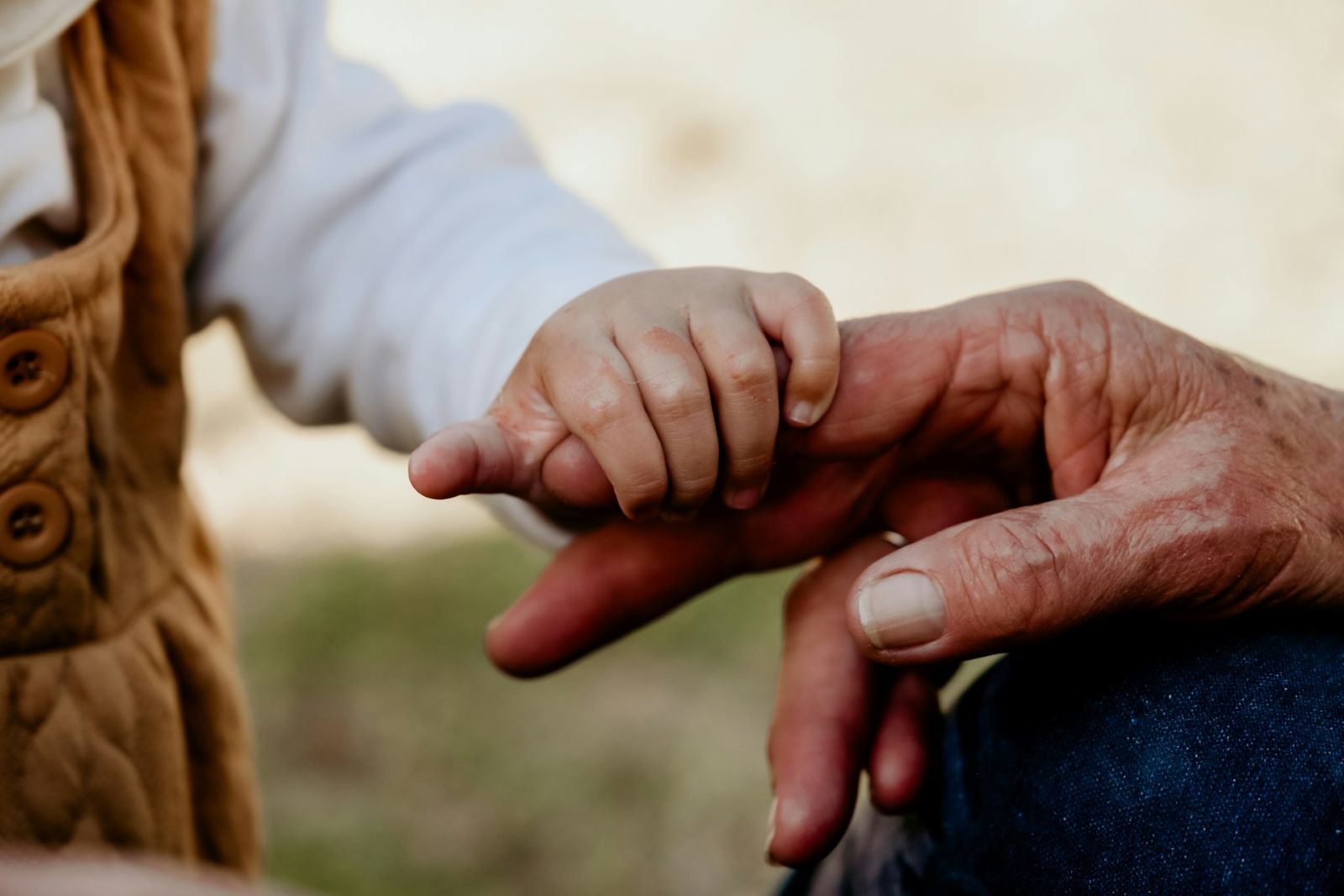
It’s OK to be attached. Photo by Loume Visser on Unsplash
My spiritual teacher says, “[N]on-attachment does not mean to leave all pleasures and remain in a state of indifference to the world. It does not mean to leave everything and go to the seclusion of a mountain cave. Those who are truly non-attached do not deny the world (or worldly life); they embrace it, for they feel the touch of the eternal hidden within all the changing forms of their lives. They are with everything.”
To me, that means non-attachment is seeing things in their true form: as an expression of the divine, which is eternal. Non-attachment means enjoying things while they’re around and remembering they are not the source of my enjoyment. I may love a person, but love doesn’t die when they leave. Non-attachment means I love God in the form of this person, but ultimately, I love God. Again, it comes back to ascribing God-hood to everything.
I’m not saying I’m no longer sad about my friend moving, because I am, but I do feel a little better because I’m reminded of what’s constant, of what’s eternal. I’m also reminded of my source for everything. My higher power will always bring me who and what I need. In fact, a few weeks ago, I rode the bus home from a meeting when normally I hitch a ride, and I ran into someone I knew, whom I had just met a few days before. It felt like a message from my higher power saying, “Your friend may be leaving, but that doesn’t mean you won’t make new friends and that your community will disintegrate. I am your source for everything; remember this all comes from me.”
I dream of a world where we remember for better or for worse, everything is impermanent. A world where we understand what’s actually constant and eternal. A world where we enjoy what’s in front of us but also practice non-attachment because we catch a glimpse of the true form underneath.
Another world is not only possible, it’s probable.
I’m deep in grief at the moment, and while talking to my therapist, she encouraged me to let Love hold me. To let it act as a container. It reminded me of a post I wrote exactly 12 years ago. Enjoy.
When I ride the bus, it exposes me to people and situations I might not otherwise encounter. On Wednesday, I rode the bus and felt like crying hearing the stories around me – the snippets of people talking about being addicted to weed, the demeanor of the woman who looked ready to punch someone, the unhoused people camping out at bus shelters. My heart broke a little because I care so much. I care so deeply. Yes, my sensitivity is probably over the top at the moment, but I can’t help that.
As tears started to leak from my eyes, a woman walked on the bus and sat in front of me. Her shirt said “love” down both sleeves. In that moment, I cried even harder because it struck me that love is the container for all things. Even while I was crying, love was still there; in this case, literally. Love means it’s safe for me to cry, safe for me to be angry, safe for me to feel whatever I feel. All of my emotions, all of my everything, really, are held in the container of love.
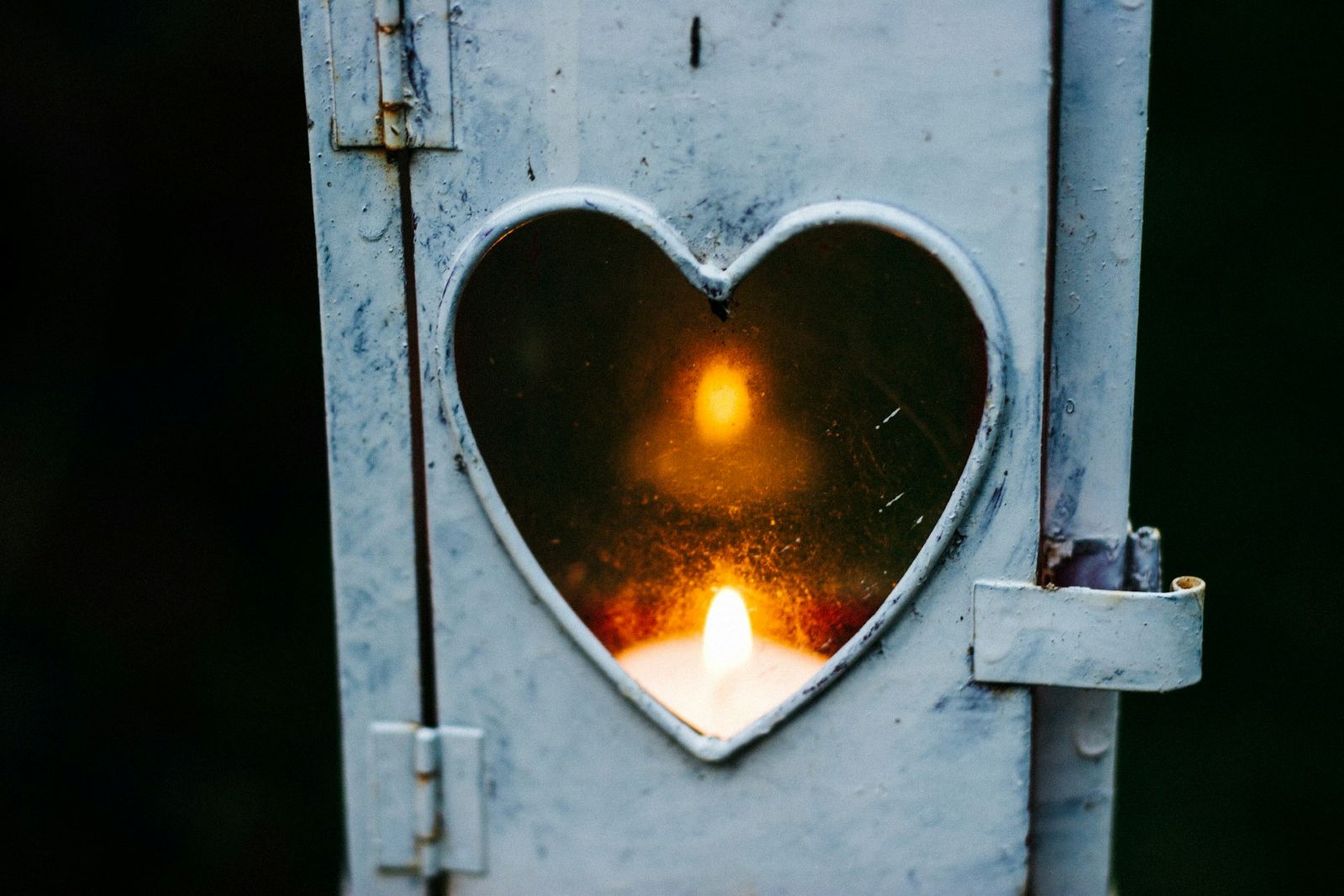
We are held by love similar to this candle lantern. Photo by Cathal Mac an Bheatha on Unsplash
Often, I think love is separate from icky emotions or things I cast judgment upon. I think there is love and then there is everything else. What I’m coming to realize, however, is that’s false. Love is not outside of all these things; love IS everything; it’s omnipresent.
Nothing escapes the purview of love; nothing is outside of love. There is a Sanskrit mantra that I sing every day, and one translation is, “Love is all there is.” For the longest time, I couldn’t wrap my head around that definition and preferred the longer version: “Everything is an expression of an infinite, loving consciousness.” But today I finally “get” it. Love holds everything, even war, disease, famine, and poverty.
Even when we think it’s not, love is there. It could be in the smile of a stranger, a call from a friend, or a feeling deep within ourselves. We are held in love even when we think we’re not. Even when the world is on fire, politicians are running amok, people are dying, and our lives are in chaos. Love is still there. This concept transcends language so to really understand what I mean, I invite you to pause, breathe, and try to feel the love that is already here, holding you.
I dream of a world where we remember in good times and bad, love is here. A world where we understand we are never abandoned by love, even if it may seem like it. A world where we let ourselves feel whatever we feel because we know that we are held by love.
Another world is not only possible, it’s probable.
Many years ago, I had a conversation with one of my closest friends about enlightenment. We compared our approaches – how I live in idealism, fantasy, and move toward the light. He told me his approach is more like crawling down the back of a scaly beast until he comes full circle at its snout. I heard what he said but I didn’t understand it because who wants to go down the scaly back of a beast? Who wants to peer into the seedy underbelly?
It turns out that I do. I’m currently experiencing the astrological transits associated with the mid-life crisis (and if you were born in 1984 or 1985, you are too). If you’re interested, that’s Pluto square Pluto, and essentially it means looking at the shadow and everything that remained hidden. It’s doing what Carl Jung suggested when he said, “One does not become enlightened by imagining figures of light, but by making the darkness conscious.”
I’m realizing how true that is. In my post from the other week about meeting the self, I talked about the importance of looking in the mirror, and sometimes, when you look in the mirror, you don’t like what you see. Some people become well-practiced at avoiding the mirror. It’s too scary, it’s too threatening to witness the parts they want to hide but that’s not me. I’m devoted to myself and that means all parts of myself.
As if to underscore this point, I pulled an oracle card called “Diving for Light.” The author Alana Fairchild says, “It can be so much simpler to seek light in the heavenly, in that which is blissful, sweet, loving, and kind. To look for the light in that which is dark is an advanced task that only a rebellious and brave heart will attempt. You may not feel that you have taken such a journey by choice. Yet you have taken this wise challenge from deep within your soul. Your innermost being has evoked this situation in your life with the intention that you grow in power, wisdom, and creative juice. It also wants you to experience a bold and fearless trust in life and become further empowered to live it with zest and courage.”
That’s true. I want to live fully. I want to liberate myself through expansion, and that means every situation, every struggle, every everything is an opportunity to move closer to the Divine Beloved or further away. My spiritual teacher says our path is an all-around fight, both internally and externally. That means facing my fears, protesting injustice, and always asking, “How can I use this situation or experience to grow?” It’s not only the happy, joyful situations. It’s also the ones that have me crying every single day.
I’m diving for the light by mining the darkness. I’m sifting through the muck looking for gold, not because I particularly want to, but because I recognize there’s something of value in doing so. On the other end of this is more power, more wisdom, more creativity, and being one step closer to enlightenment.
I dream of a world where we understand to become enlightened, we must make the darkness conscious. A world where we use everything as an opportunity to move closer to the Divine Beloved. A world where we dive for the light because we understand that something powerful and transformative is waiting for us in the shadows.
Another world is not only possible, it’s probable.