I’m not a true crime or horror kind of gal. I don’t enjoy blood or guts or gore. I don’t derive pleasure from other people’s suffering so it was curious to me why a new friend sent me a podcast about the wreck of the Grafton. The Grafton was a ship that crashed onto one of the islands near New Zealand in 1864 resulting in four men becoming stranded.
The podcast revealed all the details, all the trials and tribulations these men went through. I was riveted and disgusted in equal measure. I won’t share everything because I highly recommend you listen to the podcast for reasons I’ll reveal shortly, but suffice to say, they went through a nightmare. They had flies biting their skin and then laying eggs. They were sunburned and starving and dehydrated and sick. What they went through was horrific.
I listened to the podcast all the way through and in the last 10 minutes, I burst into tears and not because one of the men died. I won’t give away the ending because I truly think everyone should listen to the podcast, but the half-spoiler is what these men chose to do with their suffering. I’ve heard numerous tales of woe over the years and people have different responses to what happens.
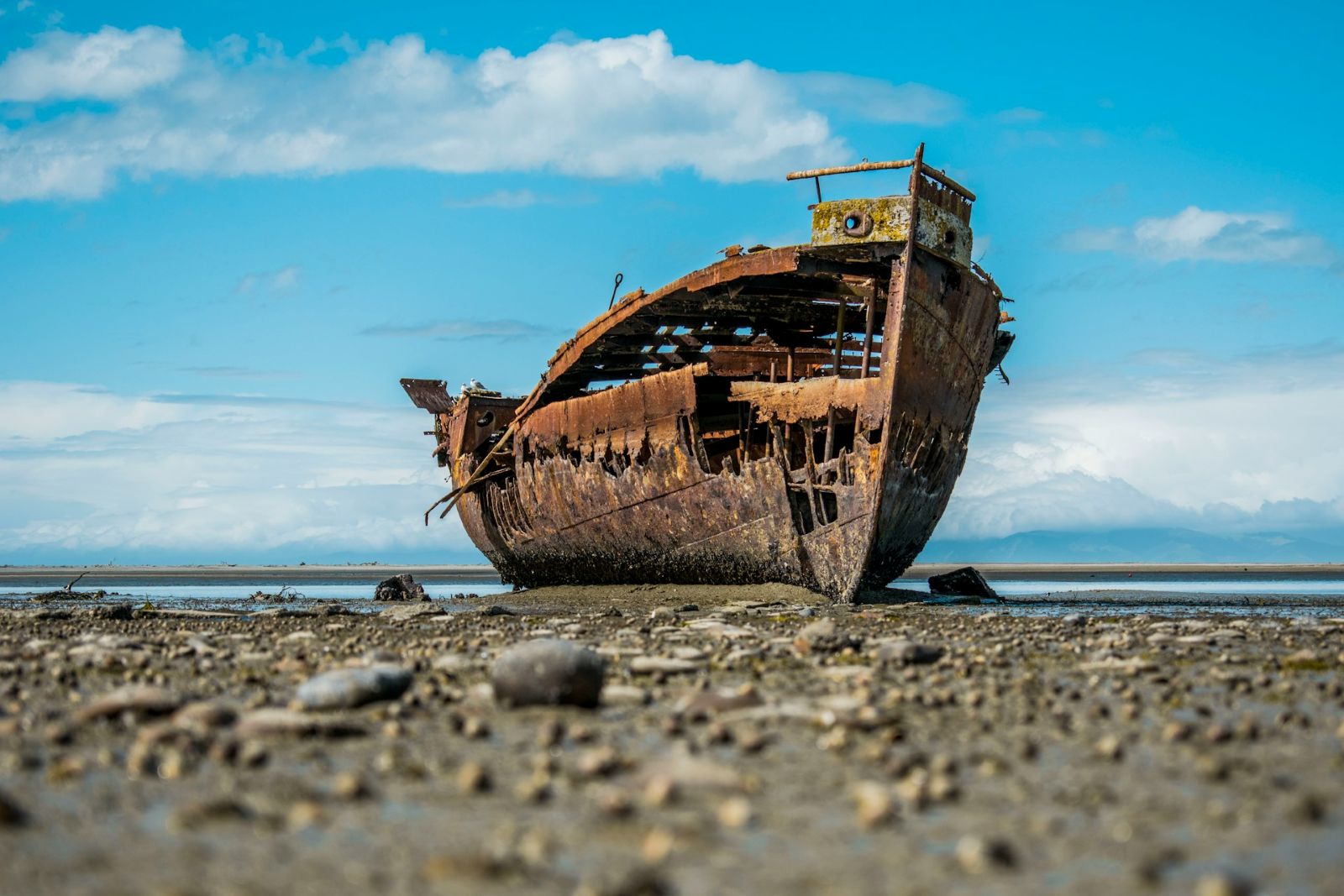
A shipwrecked boat! In New Zealand! Photo by Aneta Hartmannová on Unsplash
Some people use suffering to turn them bitter, angry, resentful. Life stops being joyful because it doesn’t make up for all the trouble they’ve endured. They compare themselves to other people and always fall short. Then there are people who become selfish jerks who only care about what happens to them. They think no one else is looking out for them so they have to look out for themselves. They use their suffering to become greedy and entitled.
Then there are people who use their suffering to be of service to others. They think, “What I went through was horrific and I don’t want anyone else to suffer the way I suffered,” so they try to help others. They seek to be a bulwark against suffering and make life smoother.
For a long time, I’ve tried to skirt around suffering but that’s not possible. In my spiritual tradition we say that “God” is an acronym for “generator, operator, and destroyer,” and that means things, people, places, and situations will be destroyed. There’s no getting around struggle, suffering, and destruction. And rather than being something separate, apart, or removed from God, it’s inherent to God.
After listening to the podcast, I was reminded we all have a choice about what we do with suffering. I can’t say, “It all happens for the best! Just wait and see!” or engage in other spiritual bypassing, but what I can say is I know it’s up to me how I handle the suffering. I can choose to be a jerk, or I can do what I’ve always done, which is take pain and make it art. I can bundle all the suffering I’ve endured, all my deep feelings, all my everything and turn it into something that touches humanity and makes the road ahead a little less lonely, a little less rocky. Not everyone will make that choice as much as I wish they would. I can’t control other people, I can’t control what happens to me, but there are some things I can control. And one of those things is what I’m choosing to do with suffering.
I dream of a world where we recognize suffering, struggle, and destruction are inevitable. A world where we understand we can’t control whether terrible things happen but we can control what we do in response. A world where we make the choice to do something with our suffering.
Another world is not only possible, it’s probable.
The other week I started a slow slide into depression because I ran out of resveratrol, a supplement I take to support dopamine production. In a quest to feel happier, I descended into an internet rabbit hole and of course a podcast from Glennon Doyle about how to live a little happier caught my eye, particularly because she featured Dr. Laurie Santos. Dr. Santos is a happiness expert and teaches THE most popular class at Yale in 300 years: Psychology and the Good Life. It’s been adapted into a free online course taken by more than 3.3 million people to date.
Dr. Santos has done a ton of research on happiness and discovered the way we go about achieving happiness is all wrong. We think happiness is about our circumstances – the job, the relationship, the house, etc., but in practice, science shows that’s not true. It’s not true because the brain gets used to anything – good and bad. For instance, when you buy a new iPhone, it’s fun for a while because it has cool new features, a better camera, etc., but then you just get used to it. It’s not the exciting, shiny thing it once was. It’s just your phone.
“We kind of get that with material objects, but we forget that with big life changes,” Dr. Santos said during the podcast. “You get this new promotion, or you get a new salary, or you get into a relationship. At first, yeah, it’s amazing, but then over time, you just get used to it. And this is hedonic adaptation; all the best things in life, we kind of just get used to over time.”
We can be happier. Photo by Tim Mossholder on Unsplash
Not only do we get used to the best things in life, not only do we forget how easily we acclimate, we also have a built-in mechanism telling us we’d be happier with more. That’s what dopamine, the happiness molecule, seeks. More Instagram followers, more gadgets, more money, more. In my spiritual philosophy, we say every human being has a thirst for limitlessness. Even when a person has so much, they still want more. Clay Cockrell is a wealth psychologist to the 0.0001% and found they are miserable because instead of being satisfied with enough, they’ll say, “I have $500 million, but I’m not a billionaire.” The millionaire wants to be a billionaire and a billionaire wants to be a trillionaire.
My spiritual teacher says:
“However great may be the wealth of attainment, it cannot satisfy the hunger of the human mind, which always yearns for unlimited happiness. Those who run after wealth and reputation, name and fame, can never be happy unless they can attain an infinite quantity of the same. But because the world itself is finite, how can the objects of this world be infinite? Besides, it is not materially possible to acquire objects of an unlimited quantity. So worldly achievement – even if it is the acquisition of the whole globe – is neither unlimited nor eternal.”
What then is the solution? How can you be happier right now and placate dopamine? First off, Dr. Laurie Santos says to change your reference point so that you look down, not up. Instead of comparing yourself to someone who is better off than you, compare yourself to someone who is worse off. That also elicits gratitude, which increases happiness.
Santos also says we’re terrible at prioritizing the things that make us happy. When we’re stressed with work, the first thing we drop is a yoga class with a friend, but socializing makes us happier. When we’re tired, we scroll Netflix, but we’d be better off playing on Duolingo, a language-learning app. Furthermore, happiness is a daily activity, not an arrival, which means you can’t write a gratitude list once a year and feel happier until the end of time. How we operate on a day-to-day basis affects our happiness overall.
Dr. Santos has more happiness tips and research on her podcast, the Happiness Lab. However, something happiness experts often miss is in order to feel truly happy and at peace, you must include some sort of practice that quenches your thirst for limitlessness. For me, that means meditating on an infinite, loving consciousness. And wouldn’t you know it, I’m happier when I do.
I dream of a world where we realize happiness is a daily activity, not a place we arrive. A world where we understand the material world will never satisfy our desires. A world where we point ourselves to something greater than us. A world where we do what we can to be happier now.
Another world is not only possible, it’s probable.