What We Can Learn from Dead-End Streets
I’m sick and feel unable to record the audio for this post. Also, I’m pretty sure no one wants to hear me sniffling anyway. In terms of why I’m resharing this post from August 2021, I honestly don’t know, but it’s what kept ringing through my head. Maybe someone out there really needs to hear it. Enjoy.
I keep thinking about an essay I read in the book All I Really Need to Know I Learned in Kindergarten by Robert Fulghum. He writes about how he lived at the dead end of a dead-end street, two blocks long, at the bottom of a hill in north Seattle. At the top of the hill, two big yellow and black signs declared: STREET ENDS. And at the end of the street where Fulghum resided, another big sign with stripes and reflectors stated the obvious: DEAD END.
You could see that “DEAD END” sign a long way off – in other words, the dead end didn’t sneak up on you. However, what’s so remarkable is people drove down the street anyway and seemed to be baffled when the street did, in fact, end.
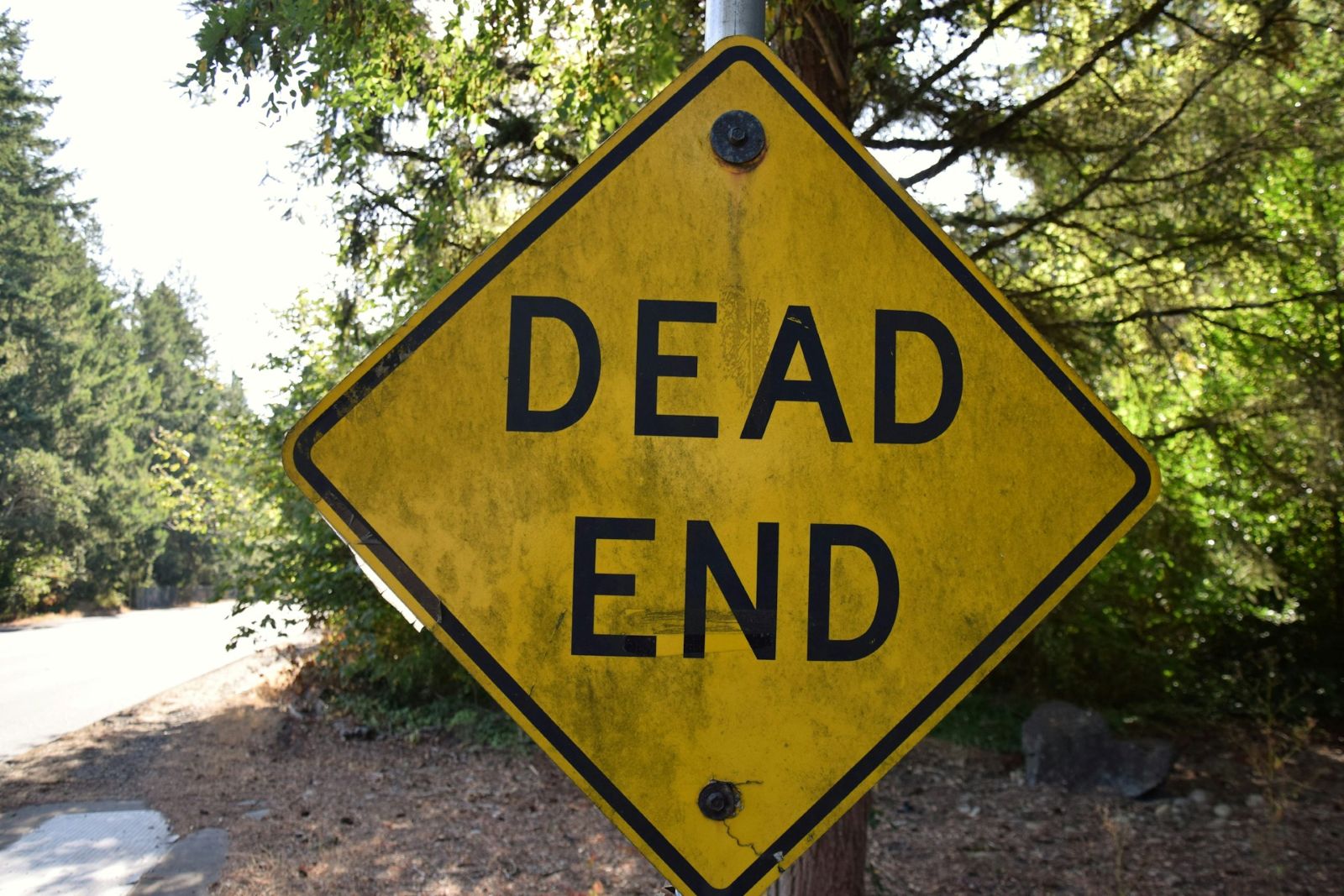
These signs aren’t just for decoration. Photo by fr0ggy5 on Unsplash
Fulghum writes:
“Not just part way, mind you. Not just to where the reality of the situation cleared up. No, sir. They drove all the way down, right up to the sign, the big black one with stripes, the one that said DEAD END.
“And they read that sign two or three times. As if they were foreigners and had to translate the English. They looked on either side of the sign to see if there was a way around it. Sometimes they sat there for two or three minutes adjusting their minds …. There was no pattern. All kinds of vehicles, all kinds of people, broad daylight and pitch dark. Even a police car a couple of times. And once a fire truck.
“Innate skepticism or innate stupidity? I confess I do not know. A psychiatrist friend tells me it’s a sample of an unconscious need to deny – that everyone wants the road or The Way to continue on instead of ending. So you drive as far as you can, even when you can clearly read the sign. You want to think you are exempt, that it doesn’t apply to you. But it does.”
His last two lines especially strike me. We want to think we are exempt, that whatever we’re confronting – a dead-end street, a deadly virus, whatever – doesn’t apply to us. But it does. I’d wager the majority of us want to feel special. We want to be right, to know the truth, and even when there’s evidence demonstrating we’re wrong, we can’t accept it. Why is that? I think one reason is U.S. culture doesn’t have many examples of people saying, “I don’t know.”
Instead of saying, “I don’t know,” we make something up, we pretend to know. We try to save face versus practicing humility and admitting, “I don’t know,” or even, “Maybe I’m wrong.” Who says maybe I’m wrong these days?!? I can’t remember the last time I heard in a public space someone open to the possibility they don’t know everything. It’s as if due to the internet and having so much knowledge at our fingertips, we’re loath to say, “I don’t know” or “I could be wrong.”
Also likely wrapped up in “I don’t know” is fear. My spiritual teacher says, “Humans do not fear to tread a known path, but they always hesitate and fear to travel unknown paths.” Sometimes those unknown paths are intellectual ones. It’s far easier to cling to a thought or belief you learned early on and is corroborated by friends and family than to change your mind and believe something new. But that’s the beautiful thing about the mind – it can be changed.
There’s nothing shameful or humiliating about saying, “I don’t know,” or “I was wrong.” No human is omniscient. We aren’t supposed to know everything, and that means we’d be better off acknowledging that’s true. We’d also be better off accepting reality when it’s staring us in the face – like when we’re confronted with a dead-end street.
I dream of a world where we understand that if there’s a road sign that says “DEAD END,” the street ends. A world we understand if we think we know something other people don’t, we’re likely deluding ourselves. A world where we’re OK with some uncertainty and we embrace the power of saying, “I don’t know” and “Maybe I’m wrong.” A world where we all learn from dead-end streets.
Another world is not only possible, it’s probable.


Oh, this text was not on those two tabs I already opened, but I’m glad I did use the link to get to this one as well…
I would add that due to the Internet in our pockets, I say or type nowadays quite often that “I was wrong”. I am good at making guesses (totally personal opinion supported by positive feedback bias), but now I have the Internet available 24/7 and can often see quite fast that I had been wrong. 🙂
The spiritual teachers and texts (whoever wrote them!) often use allegories, analogies and metaphores, because The Real Stuff by definition is not in the material, concrete world and still this world is the one we have a possibility to know and understand. Hence the stories about salt doll going to explore the sea etc.
And I think this is still needed. And reading your text I remembered a couple of other stories and my mind came up with an idea of a book(!) (or an Internet database) of stories and their corollaries, lessons in the spiritual life.
The second story was my tendency to see paths when moving in a totally or partially unknown terrain. They are often shortcuts, but sometimes just a way to experience something else, something different – because you never know! Saying “I think here’s a path” with other people close by and possibly with the intention of moving with me has sometimes given them totally new, amazing experiences, sometimes just wet shoes and frustration (to me).
What is the lesson here? I don’t know. But from my point of view, if we want to go forward, we should take some route and before taking the path it is sometimes hard to tell if it will lead anywhere or not.
The first story is about the dead-ends. In Europe we trust in graphical symbols and not so much on text (there are many languages anyway), so sometimes it is possible that people don’t really see (they *should* check) the blue sign with a white line leading to a white box which is red on the inside.
In 2001-2006 we used to live next to such a dead-end street in the hilly part of my hometown. Some of the streets are really steep there and many are dead ends. We had three wooden houses forming a housing unit. Our house was right next to the street, but we slept upstairs, like 9 meters above the ground and could not really know what was happening in the small street during the nights.
But our neighbours did. They lived (I think they still live there) close to the ground and so they told us what happened in the winter nights, especially on Fridays and Saturdays when some young people were spending their time by driving around with a car. Every now and then such a group of teenagers would get the idea to drive outside the very center of the town and eventually down our dead-end street. Well, then you need to turn around (there is space for that). But. In the winter the snow covered steep uphill is too challenging for an unexperienced driver. So. Our neigbours would wake up in their bed to the sound of a roaring car motor and have their usual discussion: Should they wait that the noise makers would somehow get up the hill or should they put on some clothes and go and push the car up the hill. They had done both.
The lesson? Sometimes you see people in trouble and doing foolish things, but what can you do? Sometimes you can put up the signs, tell the stories, but not everyone sees or cares about the signs. And when someone is lost or stuck, we may be help or not, and it is not just about our comfort. 🙂
Great points!